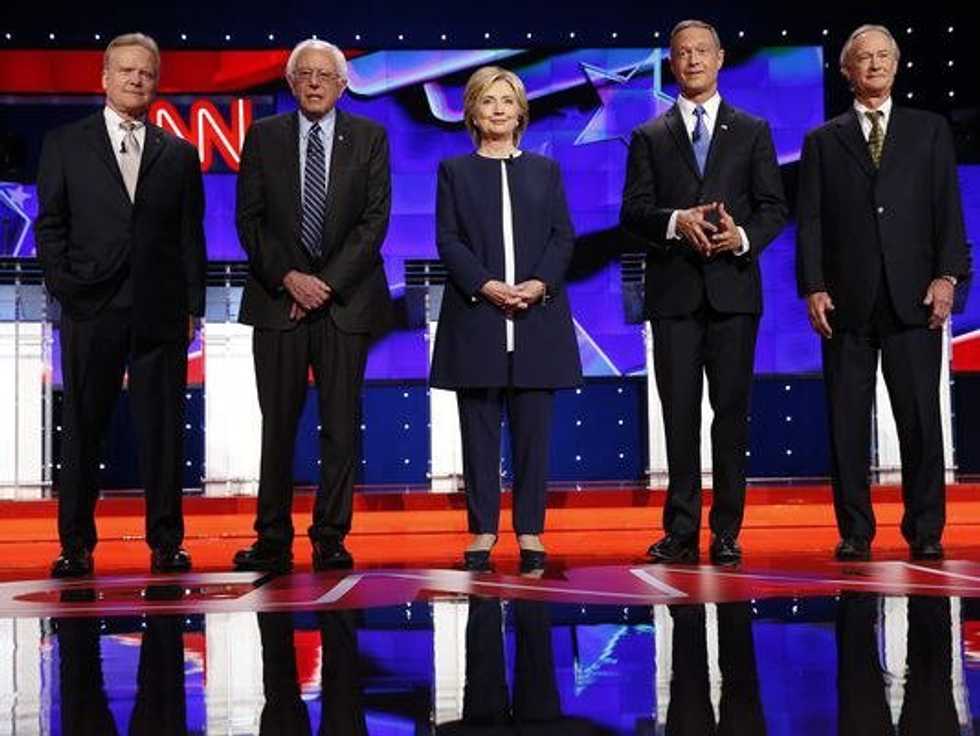
After two feuding Republican debates, including a three-hour marathon, the Democrats finally had their chance to introduce themselves to the nation. Senator Bernie Sanders and former Secretary of State, Hillary Clinton, the two frontrunners, did not disappoint in their debuts for the 2016 campaign, while Martin O’Malley, Jim Webb, and Lincoln Chafee were present.
In the early stages, Clinton was strong. She attacked Sanders' position on guns, pointing out that he had voted against the Brady Bill five times. Clinton also looked stronger on foreign policy, detailing her strategy for dealing with the Russians and ISIS in Syria, while Sanders seemed lost by talking about Putin when Senator Jim Webb began talking about the South China Sea.
The most contentious moment of the debate came when the two went back and forth on their college plans. Clinton has made the argument that her plan is more progressive because students who are well off will not receive any benefits, whereas everyone benefits under Sanders’ plan since he has promised to abolish tuition for all public universities. Clinton said she doesn’t “take a backseat to anyone when it comes to progressive experience” and that she is “a progressive that likes to get things done.” Sanders pushed back by saying that we should “guarantee education as a right.”
After this skirmish, it was pretty much all Bernie. Whether it came to regulating and breaking up the big banks, protecting the environment, fighting against institutional racism, or developing a more comprehensive healthcare system, Sanders looked stronger. When the topic of Wall Street and the Great Recession came up, Clinton had a gaffe that no one is talking about by saying, "I represent Wall Street, and I told them ‘cut it out’.” Sanders came back with his best moment of the night, saying “Congress does not regulate Wall Street, Wall Street regulates Congress.” He labeled her as “naive” for simply telling them to stop their legalized fraud.
Even when it came to defending democratic socialism, Sanders looked strong and confident. He argued that income inequality is morally wrong and that it should be remedied. When asked if he is a capitalist, Sanders said that he is not “a casino capitalist,” a bold claim to make from a stage inside a casino.
Since the debate focused mostly on Sanders and Clinton, the other candidates did not get much time. The most impressive of the three was Governor Martin O’Malley, who was the greenest candidate for proposing that we have a “clean electric energy grid by 2050.” His downside was that he came off as a stereotypical greasy politician in a time when voters love the political outsider. Senator Jim Webb complained about how little time he got throughout the night, and joked about how he killed someone during Vietnam. The worst performance came from Governor Lincoln Chafee who attempted to attack Clinton on her e-mails by saying that he has “high ethical standards,” but got hammered on his vote on the repeal of Glass-Steagall, since he did not know what he was voting on.
The most perplexing part of the debate was the aftermath. As Business Insider details, Sen. Sanders won according to Fusion’s millennial focus group, CNN’s focus group, and Fox’s Florida focus group. He also won many online polls, none of which are scientific polls, but they still had him winning by a wide margin, giving us an impression that he won the debate.
However, the mainstream media did not cover it this way. Pretty much every headline talked about how Clinton had won and that the Democratic Primary is a one-horse race. The most egregious example of this is CNN, who had Sanders winning their poll by over 57 percent, next to an article describing a dominate Clinton in victory. CNN ended deleting their poll so that the narrative they pushed became true.
This is the establishment at its worst. Sanders won this debate and the media has done their best in trying to deny him this victory. Don’t believe the hype from the mainstream press, they are consistently wrong when it comes to making predictions. They dismissed Trump at the very beginning, but now he has been in this race for a while and knocked out establishment candidate Scott Walker.
The Democratic Primary will be a long contested race between Clinton and Sanders. Clinton has many advantages in her fundraising, the size of her team, and her lead in many states. But Sanders has taken the lead in New Hampshire, and he generates a lot of enthusiasm from millennials. To count him out this early would be as foolish as anointing Clinton as the nominee in 2008.