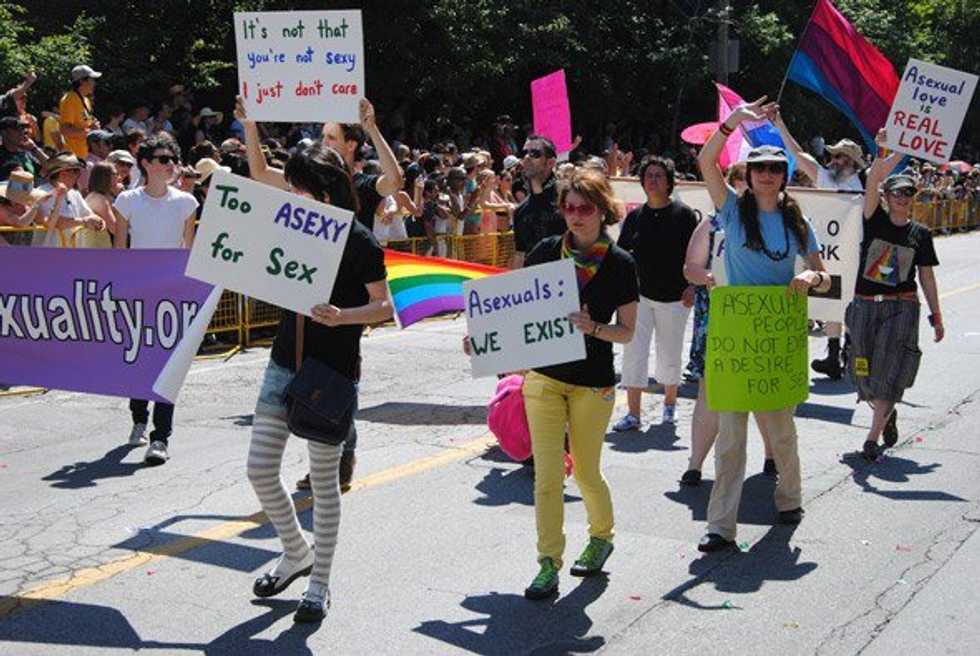
"Asexuals need LGBT solidarity like a male-bodied person needs a gynecologist."
An "innocent" comment made by an anonymous member of the queer community, a male expressing their views on asexuals and their place in the community. At what point does it stop? When do these statements finally qualify as identity policing?
The following opinion is not meant to tear the queer community down, nor act as the "ultimate call-out post." However, it's time to face hard truths and reevaluate the concepts of inclusivity and exclusivity within queer spaces that are otherwise brushed over.
As a member of the asexual spectrum for about four years now, I know all too well the bias against asexuals in the LGBT community is unfortunately alive and well, and it easily worms its way into the minds of many. The discovery of my own identity was rocky. While over the past few years I have also realized that I am gray-panromantic and do not identify with any gender, I would still argue that my asexuality was the hardest to pinpoint.
That being said, I've seen it all -- whether through my own discovery or the opinions of others, I know how easy it is to fall into the discourse, to slip into the mentality of, "Isn't the queer community inherently about being sexual? Am I really any better than any of the heterosexuals claiming oppression?"
Especially through social media platforms such as Tumblr and AVEN.org, a website designed for those on the asexual spectrum, the discourse is evident, and it takes a toll on the mind of both long-time aces and those newly questioning their asexuality alive.
One blogger expressed her thoughts on asexuality, stating among other claims that:
"This is [also] why many queer people are really offended by asexuality trying to claim queer. Part of our struggle is to have our sexual expression accepted, and that cannot coincide with a group that promotes lack of sexual expression as an identity."
This is a typical sentiment expressed by those who do not inherently understand asexuality, unfortunately. Asexuality is not an orientation which is meant to condemn those who are sexual, in fact, many asexuals identify as sex-positive (meaning they are supportive of those who have sex.) Rather, asexuality is meant to finally give those who lack sexual attraction a place to find those who relate to them. In fact, until the DSM-V, which was released in 2013, asexuality was listed as a mental disorder, just like homosexuality.
The difference? Homosexuality was declassified as a mental disorder in 1973, 40 years earlier. This is not to say that those who experience same-sex attraction in any identity magically lost the stigma surrounding them, rather, it is to counter the thought that "in no way is asexuality an oppression" and "the worst you get is misunderstanding and erasure?" from someone who then goes onto admit that asexuals do experience corrective rape, but disregards this as a side effect of solely rape culture. Asexuals have been forced into sex therapy for 40 years longer than sexuals have by medical professionals, asexuals have been persecuted by religious communities, by nonreligious communities and by heterosexuals that cannot fathom the lack of sexual attraction and therefore express their hatred towards us.
But, we're still allegedly not oppressed.
Consider the following synthesis of the situation by a member of the asexual community:
"If you heard people telling a gay person that they don't know they like the opposite sex until they try sex with them, or that there must be something wrong with their hormones or their mental health - you would be disgusted. You would have no doubt that these people were being oppressed and invalidated. So why do you think it's any different for asexual people?"
An asexual's experience, whether they are heteroromantic or not, is never going to be the same as a heterosexual person's experience. They are not the same thing, and conflating the two is downright ignorant."
When the oppression's there and the arguments are laid to rest as they have been time and time again, yet asexuals still don't have the right to call themselves queer (nor feel safe in queer spaces), it's time for a serious reevaluation of inclusivity.