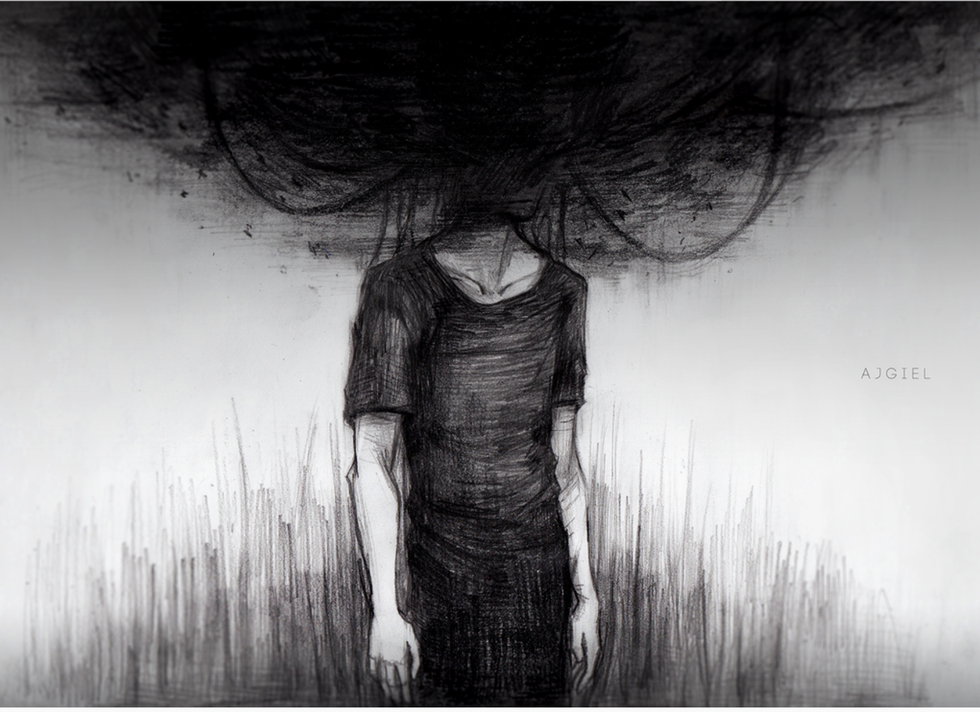
I am going to die.
As she is waiting on the bench at the nurse’s office, Elizabeth’s thoughts gnaw at her, her pulse is racing, and she can’t breathe; but finally, the nurse comes into view. Elizabeth looks hopefully at the nurse in need of desperate help, anything that will assure survival. The nurse instead directs her attention to a boy who just strolls into the office with a small, non-threatening scrape on his hand from gym class. “Hold on,” the nurse tells Elizabeth “let me take care of this first.” Hold on? I am about to die. I can’t breathe. I can’t think. I have no control over my life. are the thoughts that race through her head. Elizabeth does not speak.
Recounting this experience, Elizabeth tells me “I felt so invalidated. I blamed myself. I questioned myself, asking myself over and over again why was I bothering them and why was I overreacting and what was wrong with me?”
To answer what was wrong: a panic attack induced by her severe anxiety and depression.
Because mental illness mainly consists of symptoms that can only be internally evaluated by the sufferer, people have a hard time pinpointing exactly what these mental disorders are. How was the nurse supposed to take this seriously if, unlike the scrape, there were barely any visual symptoms? How would the nurse know? How would anyone know?

Here we run into the problem that causes the stigma surrounding mental sickness: the vague nature of diagnosis.
'Stigma' can be defined as a disgraceful reputation that causes people to shy away from the particular object of discussion. According to Dr. Peter Byrne, MB MRCPsych in his 1997 paper “Psychiatric Stigma: Past, Passing, and to Come”, the stigma surrounding mental illness is due mainly to these stereotypes:
1) People with these disorders are meant to be marginalized
2) Affected peoples simply cannot cope with life, they are weak charity cases
3) all mentally ill are volatile and violent, vice versa
4) the patient is unwilling to recover simply because they are lazy.
It’s easy to deny that the stigma exists, after all, we all like to believe we are understanding and compassionate. It’s also easy to deny the fact that many of our loved ones, or even ourselves, could possibly suffer from mental illness because of this irrational impulse to believe that surely you or those who you value so much could not be those inferior people suffering from mental illness. In reality, about 20% of people in the US suffer from mental illness. That is one-fifth of the population of varying personal backgrounds; there is an extraordinarily high possibility you not only know, but also are close with someone who suffers from mental illness. It can affect anyone, at any time, for any reason, or for no known reason at all. Yet, the stigma surrounding mental illness that creates a certain pressure to not seem inferior, that these people tend to make the effort to stay hidden.
First off, people with these disorders are not meant to be marginalized. Rowen who has been diagnosed with anxiety and OCD (Obsessive Compulsive Disorder), has had people deny that she could possibly have mental illness. She states, “the worst reactions [to my diagnosis] are when people don't understand these disorders but they mean well (e.g.: "oh, don’t worry, you don't have OCD") but yes I do, and I don’t have to appear obsessively organized to fit your perception of OCD”. Rowen, can still be the fun dog lover and actress that her friends and family adore; she doesn’t have to be marginalized, to have isolating "crazy and weird" traits, to have mental illness despite popular belief.
Also, affected peoples are not simply weak charity cases who cannot cope with life. This pressure of the stigma has led military trainee Gene to tell only a few people (other than his parents) about his struggles with his diagnosis of depression. And these people, these trusted people who Gene opened himself up to, denied his diagnosis. They are surprised and don’t believe him. Gene would like to agree with them, but the depression diagnosis by three different doctors contradicts his rationale to do so. Gene, a positive leader training for the military, can have depression and it’s not a weakness.

Additionally, violence does not guarantee mental illness and vice versa, unlike how the popular media portrays this relationship to be. The media is flooded with news of mass shootings and movies, such as “Suicide Squad” and the popular “Batman” movies etc., depicting brutal criminals as mentally ill figures of entertainment. For example, the homicidal and maniacal antagonist of superhero Batman, Joker, is commonly perceived by the audience (and even Batman himself) as mentally ill for he is repeatedly hospitalized at the Elizabeth Arkham Asylum for the Criminally Insane. However, according to forensic psychiatrist Vasilis K. Pozios, M.D. “in real life, [Joker] probably wouldn’t qualify [for the asylum]” based on the medical guidelines diagnosing patients with a mental illness. So why is it that we automatically assume that the Joker is volatile and violent on account of a mental illness?
Lastly, the patient’s impeded recovery isn’t simply caused by laziness and unwillingness to overcome everyday strife. An interviewee who has been afflicted by post-traumatic stress disorder (PTSD) has been hurdled by chides of "get over it” and “any comparison of [her] life to any other life followed by the phrase ‘you've got it so good.’” This particular interviewee’s parents do not even believe the diagnosis; they don’t believe that mental illness even exists. Imagine having cancer and instead of love and support from those who should love and support you the most, you get a denial that you even have cancer, or that cancer is a real disease. The struggle of mental illness is as real as the struggle of cancer is. In fact, one of my interviewee’s mothers was diagnosed with both cancer and depression, and she said, “I’ve gone through my fair share of illnesses; I’ve gone through cancer, but the one I would never wish on my worst enemy is depression”.
So how can we defy the odds of the stigma surrounding mental illness and actually help those suffering? For starters, realizing that people suffering from mental illness are wholesome people, and that the illness is only a part of their lives. Be aware of how you are reacting to the news of diagnosis and accept that you may not know exactly how to help them but be willing to learn and support them in a genuine way. Althea says that the best reactions to her depression diagnosis are “the realest reactions. I know often people ‘don't know what to say’ but that's the thing, they shouldn't need to. I appreciate when I can tell someone's reaction is genuine and supportive. I don't like when people try and force me to talk about it with them, but appreciate when they show me I can if I needed to.” Another interviewee said that “in a state of complete turmoil, they would drop everything and come. Any time he felt invalidated, even if he didn’t believe them, it was nice to hear [their validation of him],” he reflects. Even near strangers can help one another through simple acts of kindness. One interviewee’s aunt’s neighbors helped her water her flowers and care for her cat post-hospitalization for a suicide attempt. Many didn’t even know that the interviewee’s aunt had attempted suicide, just that she was in the hospital. Just the simple acts of kindness really helped the interviewee’s aunt deal with hardship.
The bottom line is: be supportive and be willing to accept that you may not know how to help people with mental illness so be willing to ask and listen for those answers.