

"Dear board of education,
so are we."
- Propaganda in his song "Bored of Education"
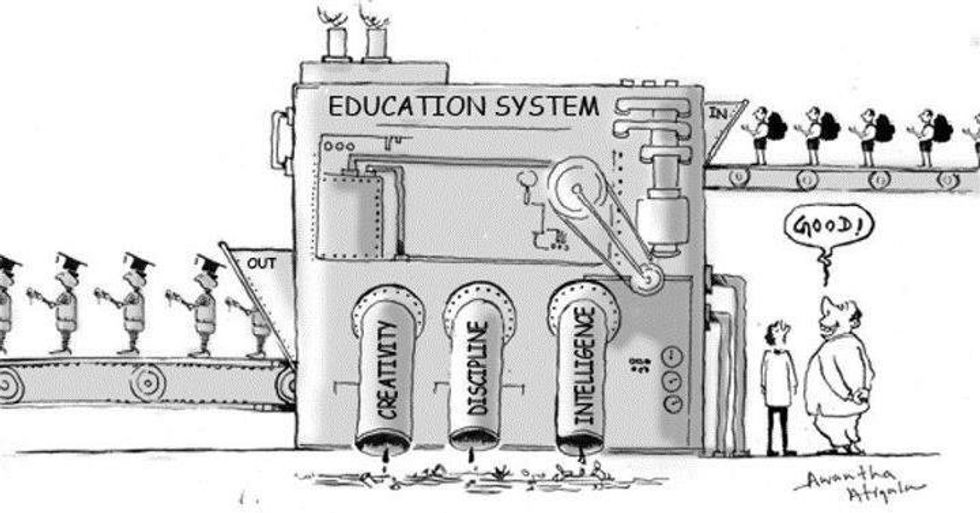
So many times throughout public school and even in college, I've thought about how having to learn and the expectations of performance and a specific definition of comprehension have taken the joy out of learning, discovery, and personal growth through education. So many people say that they hate school, but what they really want to say is that they hate the system. Now, I'll preface this by saying that this article isn't going to give a mind-boggling, new argument. I haven't come up with some fascinating, unseen reason why children have grown to abhor schooling. This is not an extensive list or argument, I'm just speaking on my own experience and thoughts.
Thankfully, I was privileged to spend my last two years of high school at an incredible school which challenged me and pushed me to think deeper, work harder, and take advantage of the knowledge at my fingertips; however, the same plague of performance and a relatively strict curriculum remained. Don't get me wrong, I've always thoroughly enjoyed school and enjoyed learning, but the expectations of tests and performance are evident for all from the onset of elementary school benchmark exams. As I've thought for years, "No Child Left Behind" might as well have been called "No Child Pushed Forward." I can get behind some sort of standards, but the mold has become too stiff overtime and much of education, especially in the south, has revolved around making sure everyone meets standards rather than pushing children to exceed them.
Education in the south has typically been much worse than in other parts of the country, so some of my experience definitely reflects that, but generally the American school system seems to take the passionate fire of discovery and curiosity innate in children and choke it out, making it the same dull burn as their peers. Classical schools, schools dedicated to liberal arts, and schools such as the one I attended that emphasize personal growth, character, and discovery in different subjects (specifically math and science) are working to change this, but the deeply embedded idea of what education in the United States is supposed to look like won't be easy to change.
Like many students, I tend to enjoy most of a class ... except being tested. Exams are stressful and not always a good measure of students in courses. In almost all types of classes, it comes down to being able to memorize information, knowing how to apply concepts that are foreign to the real world, or write in a way that is pleasing to your instructor. As I recall from an essay I read last year by John Taylor Gatto, it seems that we're just getting "schooled" rather than educated. Gaining knowledge, but not growing. Proving mastery of a topic or understanding of concepts is needed in some fashion, and memorization is necessary in languages and sciences many times, but there should be a higher emphasis on discussion and exploring ideas rather than being able to regurgitate information from hours spent in lectures.
In past English classes (I'm biased), I've definitely seen exploration and free thought more. English and the humanities in general tend to have more room for discussion and criticism due to the very fact that there is much that isn't absolute in texts of writing and other forms of art. One can write an essay arguing a point that they see in a given piece or text that is unique and others can weigh in on it and further knowledge and thought on it. Here there is a conversation rather than a check in a box. My current history teacher, and many more at Baylor and all around the country, are skilled at facilitating discussion and making students think about things such as motives, global impact, the role of the writers of history, etc., rather than just stating the facts of the past and expecting students to memorize them. There is still some of that, but an emphasis on having to think and reflect on primary sources and supplemental texts allows students to gain more than just stale knowledge.
On another note, so many people I know tell me that they don't like reading. These same people have probably read a library worth of Facebook statuses, Instagram captions, witty articles, and song lyrics, unaware that their previous statement isn't necessarily true. I'd argue that school has played a part in this as well. Many think that all books are stuffy, difficult to read classics that only Ph.D. English professors enjoy or that all poems are grandiose, meaningless descriptions of nature or ambiguous words put into rigid forms. Both are simply fallacies. Again, like much of modern schooling, which texts are taught in schools are changing, but perhaps not quick enough. I love some classical literature -- sure -- but in a way it can put people off to reading and English, closing their eyes to all the great literature that exists in the world. I stand by the old quote, "If you don't like reading, you haven't found the right book," as a remedy for this on a personal level. You do like reading, just not what you have read.
Even the very association of school and all of its perils, social and educational, can make learning seem like such a burden rather than an adventure into uncharted territory that one deeply desires to explore. Having a specific place carved out for students is another large factor that makes people not want to go to school. Students across the nation complain that school tends to shower them with an introduction to a multitude of subjects and a vast knowledge of things they are uninterested in or will never use, while discouraging them from pursuing what they are passionate about. Curriculums are strict, rarely allowing young minds to find out what they truly want to pursue in life. This is a hard point to address, but a paramount issue that must be addressed to improve education.
Many aspects of the American school system have worked "fine" for years and many evidently need changing. There's no perfect way of schooling, but I believe a compromise between the old and new can be reached that adequately measures students and provides a great education to all, yet gives space for thought, discovery, and for passions and interests to be cultivated. This is a continued conversation that will hopefully lead to widespread change someday.

















