From the moment I was exposed to artist Henri Matisse in my high school art history class, he has undoubtedly been my favorite artist. His artworks immediately intrigued me with their vivid colors and unique disposition. Not only do I think that his works are exquisite, but I also find him to be an inspiration, both as an artist and as a person.
When he was growing up, his mother bought him an art set to aid his recovery from appendicitis. “From the moment I held the box of colors in my hands, I knew this was my life. I threw myself into it like a beast that plunges towards the thing it loves,” Matisse said.
Matisse’s passion for art and creativity was apparent in everything he did. He is most remembered for being the father of the Fauvism movement. Les fauves, French for “wild beasts”, is a style that is characterized by painting based on feelings instead of visions at face value, with bright, intentional colors representing emotion.
What inspired Matisse to go forward with this avant-garde style was his desire to think outside of the box and to follow his artistic intuition. When he studied art in Paris at the Académie Julian, he learned the fundamental lessons of classical painting. While this helped him develop a strong foundation and technical skills, he detested the “overly perfectionist” style that stifled his creativity. He was always known to be a bit of a rebel in his studio classes. Later, he worked with John Peter Russel on the island Belle Île (off the coast of Brittany, France), who introduced him to the works of Vincent Van Gogh, Paul Cézanne, and Paul Gauguin. After being exposed to innovative ideas and fresh scenery, Matisse's style changed completely. "Russell was my teacher, and Russell explained color theory to me” Matisse reflected. This emphasis on color helped define the rest of Matisse’s career.
Since the south of France had a strong, inspirational influence on Matisse’s style, he officially moved to Nice in 1917. According to Matisse, he thought that the bright, warm colors that surrounded him there showed him, "Simpler venues which won’t stifle the spirit”. He furthered that his spirit became loyal to the "silver clarity of light" in Nice. He lived in a beautiful place that allowed him to create wonderful art. Matisse led an incredibly successful career on his own terms. Away from the restrictions of Paris, he was able to explore his creativity and paint in his own style. He broke rules and expectations because he knew his work was revolutionary. He followed his heart, painted what he felt, and is now widely celebrated because of it.
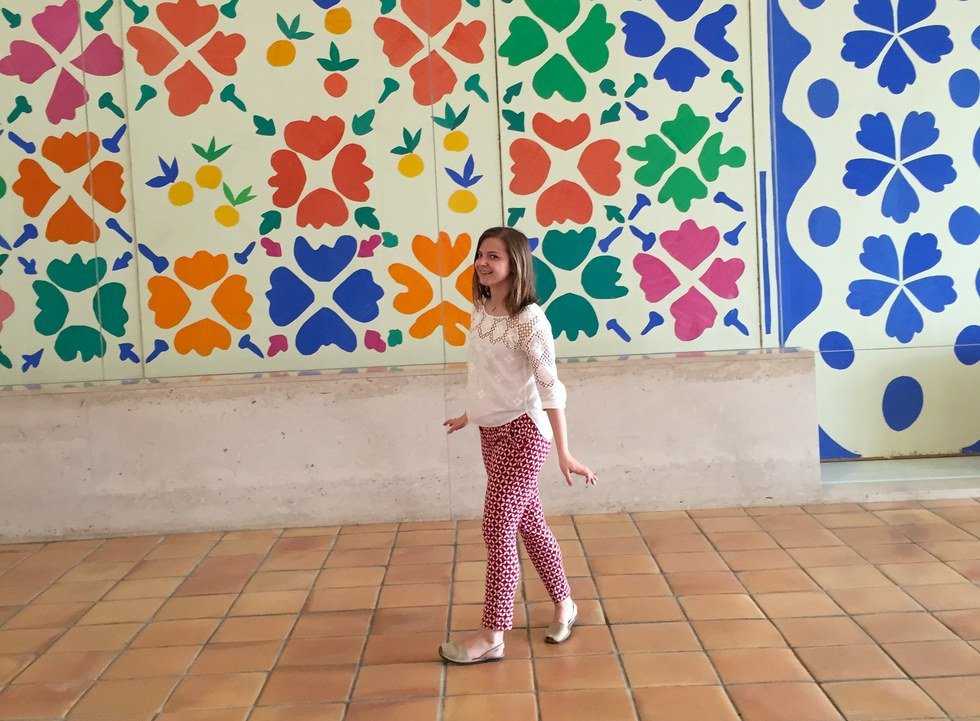
When I traveled to the South of France last weekend, I was lucky enough to visit the actual Musée Matisse in Nice. The museum houses just some of his most incredible works, as well as ample information about his life. Even though a majority of the information there was in French, I still learned a great deal about my favorite artist. It was an indescribable feeling to be standing in his actual house, and to see his story unfold in front of me. I had previously seen some of his pieces before in the Museum of Modern Art in New York, and in the Art Institute of Chicago, but I’m always very excited and eager to see more. The works I saw were all very different and special in their own ways. There were paintings, sketches, sculptures, and even plans of the Chapel he designed, called the “Chapelle du Rosaire de Vence”, which left me feeling inspired while appreciating his work.
During my trip, I saw Aix en Provence, Marseille, and Nice. Out of the seven countries I have visited, I can now say that France is my favorite. It is so scenic and quaint; the food is to die for, and there was so much to see, do, and enjoy. When in Nice, I was enamored by the stunning beach that was full of smooth stones instead of sand. My friends and I drank piña coladas on the beach with the sun shining on our faces, after enjoying lavender sorbet (which is local to the south of France). Later, we climbed up what seemed like a million steps up to the “Castel”, and then through this park that led to a waterfall at sunset. It was the most beautiful day of my life! Nice was picture perfect- I can completely understand why Matisse chose to reside there. No artist could fail to find inspiration in such a place.
Matisse is one of my heroes. I can easily relate to the person who “marches to the beat of their own drum”, and thinks outside of the box. He was completely original in his artistic expression, and created his own style when the restricting, common style of painting in Paris just wasn’t for him. He relocated to a place that inspired him, because his passion was that important to him. Matisse moved to the best place to produce the best art. In the museum, his work called “The Swimming Pool (La Piscine)” wrapped around the walls of its own room. The piece was inspired by a trip to his favorite pool in Cannes, France. Upon returning to his Nice home, it was hot, and he announced, “I will make myself my own pool”. He started the piece in 1952, and continued to work on it from his wheelchair until his death in 1954. That is just one indication of his undying dedication to art, even under adverse conditions. The swimming pool consists of blue paper cut outs, combined into the fragmented silhouettes of swimmers, divers, and stars. It is inventive, and it is his own. Matisse never let the influence of others change who he was, what he believed in, and what he created. He was always unapologetically himself, and I respect his authenticity. My favorite quote by him is, “Creativity takes Courage”. I think that statement encapsulates his essence completely.