

I was introduced to chess at a relatively early age when my dad taught me how to play. I immediately fell in love with the intricacies of the game. At first, it was just a game to pass the time; the goal whenever I played against my dad was to become good enough to beat him. Before too long, I got my first chance to say "checkmate" to him, signaling I had beaten him, and, as the years went on, I had the opportunity to say "checkmate" more frequently. It was a proud moment for me to realize how far I'd come; I was now at a point where I could consistently beat my dad.
Yet, the more and more I played chess, the more I realized how true my dad's words were when he first introduced this game to me: "When you play chess, you aren't just learning how to play a game, but you're also learning lessons about life." Honestly, when he said that, I blew him off, not paying much attention. I filed it away into the inner recesses of my mind, assuming that the only real lesson to be learned from chess was simply to plan ahead; that seemed to be the only real lesson to be learned. Only recently have I realized how wrong I was to dismiss those words so easily.
Chess is so much more than just planning ahead. If you spend the whole game with only one plan in mind, the only way you win is if your opponent makes every move you want and expect them to make, which is highly unlikely. Because of that, one has to have multiple plans in mind, being patient in setting up moves as well as being ready to fall back on another plan in order to move forward. The amount of thought that goes into planning is much more than the simple phrase "planning ahead" suggests.
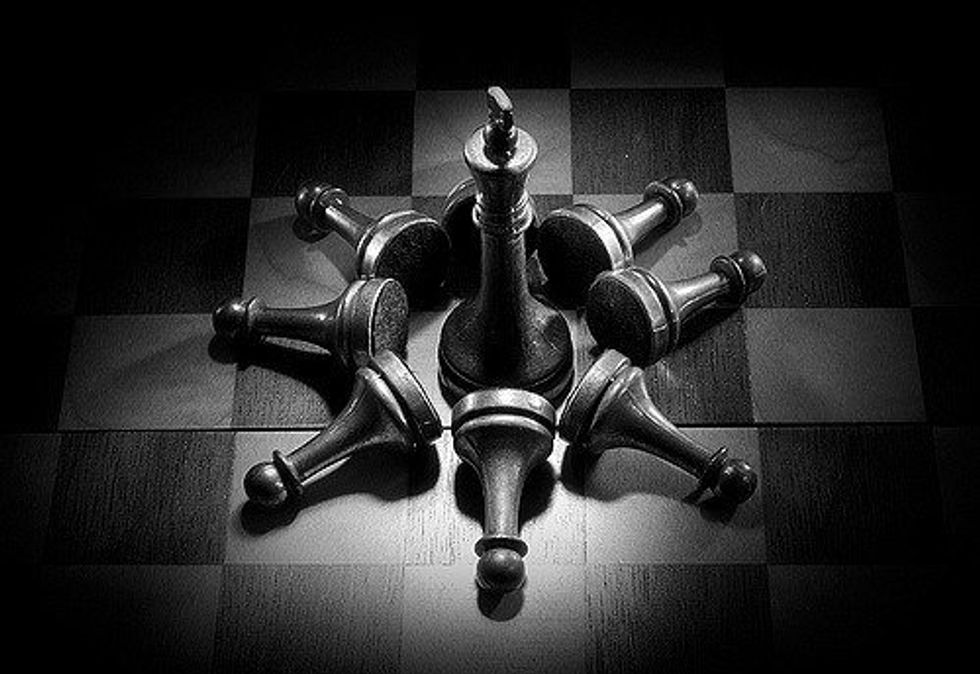
Planning ahead means knowing what order to move pieces in, knowing what pieces can be sacrificed to achieve a goal, and preparing for a multitude of moves that may be thrown the player's direction. You also need to keep in mind that you can go from having complete control of the game to being in checkmate (and vice-versa) in a matter of seconds. The outcome of a game could come down to one measly pawn, the weakest piece at the start of the game becoming the determining factor at the end.
All these aspects of chess I listed are perfect examples of the lessons of chess that can directly translate to lessons for life. Going through high school, it felt like I had life all mapped out: graduate high school, graduate from college, then go to medical school. Yet here I am, in the midst of my freshman year of college, and I'm not even sure if I want to study anything biology-related for the next few years, let alone take tons of biology classes to make it to medical school. My plan for life may not be what happens, and that's alright. I work on backup plans, seeing my other options and understanding what interests I should give up for the benefit of pursuing my deeper passions. My weaknesses, my "pawns," could very well end up being my greatest strengths, eventually leading me to success.
The game of chess has so many layers to it and is filled with relatable lessons most, if not all, people can resonate with. We are all in our own chess games in life, trying to reach that elusive "checkmate" that signals our success. Life can be difficult; it will force us to change plans and to make sacrifices we may not necessarily want to make, but that does not mean that defeat is inevitable. Learn lessons and be inspired from this simple board game; it can change the way you go through life.

















